Creality's Range Explained: Multicolor Printers, a Resin Machine, a Laser and a Scanner
Four filament printers, a resin printer, a laser engraver and a handheld 3D scanner from Creality's range. What each is built for, the key specs and which one fits you.
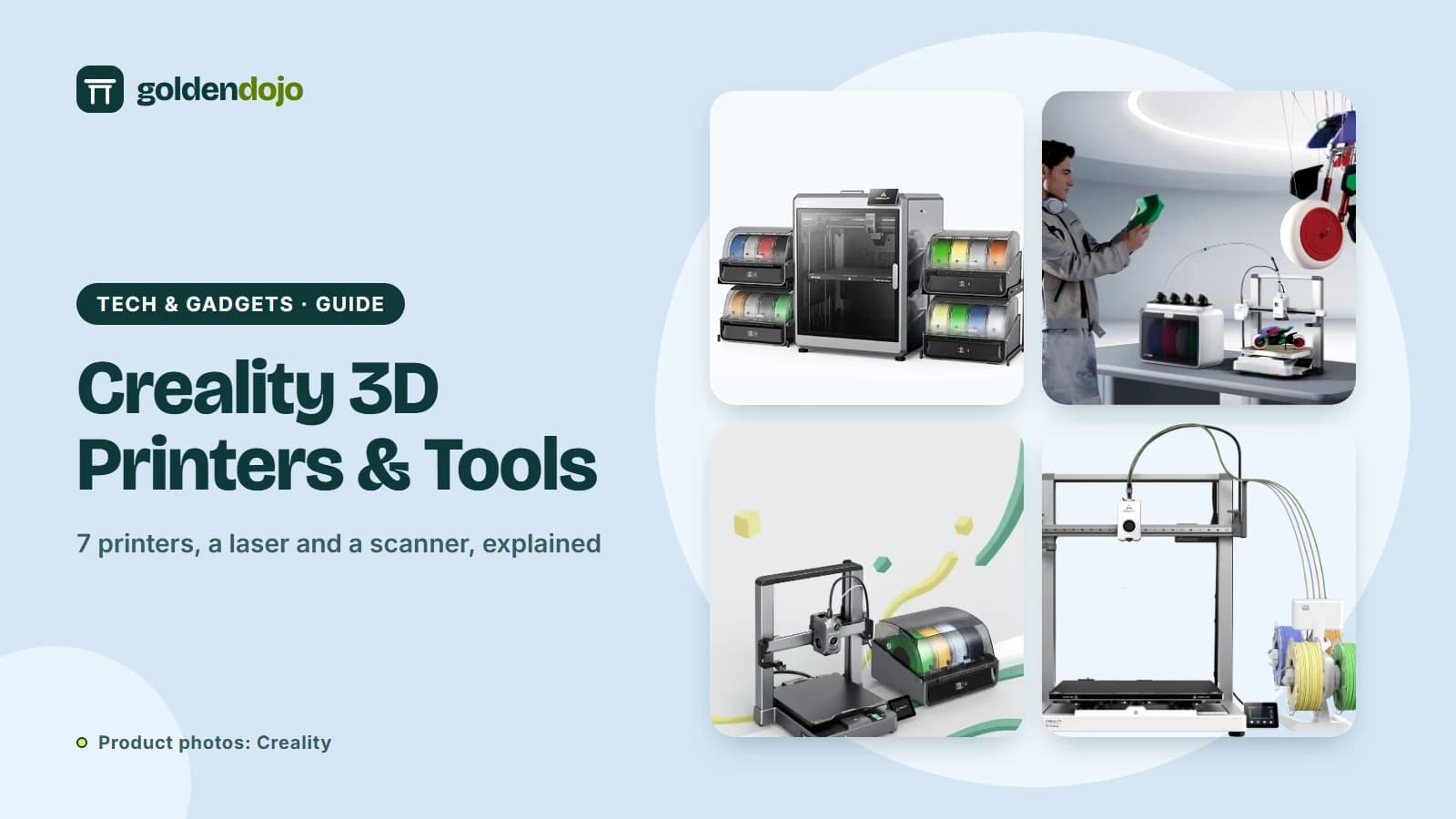
Creality is one of the best-known names in desktop 3D printing, and its official store has grown well beyond the Ender printers it started with: the K series and SPARKX for fast multicolor printing, the Hi for a lighter-weight multicolor option, HALOT resin printers, Falcon laser engravers and the Pika handheld 3D scanner. That variety is useful, but it also makes it hard to know where to start. This guide picks seven products, one per product line, explains what each is designed for and sets out the specifications Creality lists, so you can compare them on equal terms.
It suits first-time buyers choosing a series, hobbyists ready for multicolor or larger prints, and makers who want to add engraving or scanning. It does not provide independent test results: we have not hands-on tested these products, so everything below comes from Creality's official product pages and is described as the brand's claim. If you are also looking at another brand, our guide to ELEGOO's range covers a different set of machines.
At a glance
- K2 Plus Combo: large-format enclosed printer with a 350 mm cube and CFS multicolor
- SPARKX i7: beginner-friendly multicolor desktop printer with an AI camera
- Creality Hi Combo: mostly pre-assembled multicolor printer, 260 × 260 × 300 mm
- Ender-3 V3 Mega: 420 mm large-format printer for TPU and big builds
- HALOT-X1 Neo: beginner-friendly 9K resin printer
- Falcon A1C: home laser engraver with interchangeable modules
- Creality Pika: 260 g handheld AI 3D scanner
K2 Plus Combo
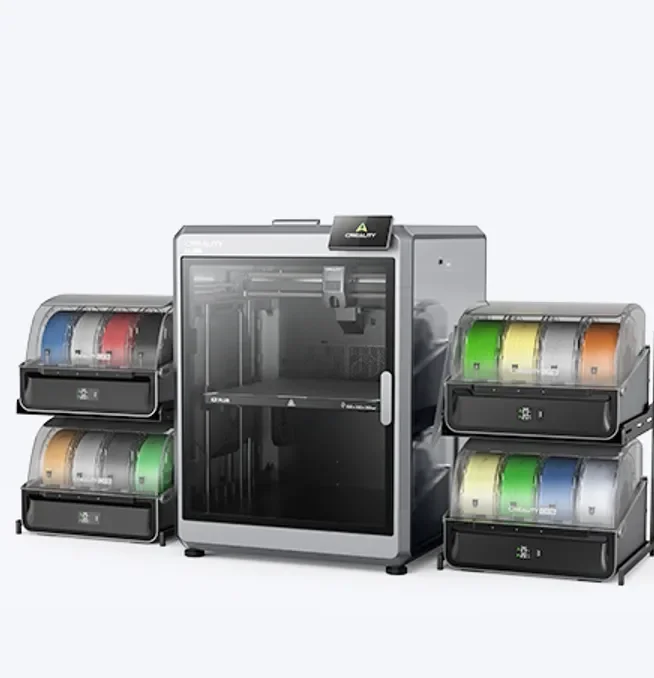
The K2 Plus Combo is Creality's flagship large-format multicolor printer. Creality describes it as the first desktop printer to use industry-grade FOC step-servo motors for the XYZ axes and extrusion, with five motors working together, each offering 32,768 controllable microsteps per revolution, for precise, quiet motion.
Size and color are the headline features. The build volume is 350 × 350 × 350 mm, and the CFS (Creality Filament System) feeds four colors. Connecting up to four CFS units gives 16 colors, though the Combo includes only one unit, so the other three are extra. An actively heated chamber reaches up to 60 °C for ASA, ABS and PPS, and the hotend reaches 350 °C with a hardened steel tip for wear-resistant materials.
Speed is quoted at up to 600 mm/s with 30,000 mm/s² acceleration, and Creality says noise stays at or below 45 dB at 300 mm/s. Dual AI cameras monitor flow and alert you to failures, and an active belt tensioner uses a pressure sensor so you do not tension belts by hand.
Key specs (Creality):
- Build volume: 350 × 350 × 350 mm
- Speed: up to 600 mm/s, 30,000 mm/s² acceleration (typical 300 mm/s)
- Hotend: up to 350 °C, hardened steel tip, 40 mm³/s ABS flow at 280 °C
- Chamber: actively heated up to 60 °C
- Multicolor: CFS, four colors per unit, up to 16 with four units
Best for: pros and ambitious hobbyists who want large multicolor prints and engineering filaments in one machine.
Creality K2 Plus Combo
A 350 mm cube printer with CFS multicolor, a heated chamber, a 350 °C hotend and dual AI cameras.
Opens the Creality store page in a new tab. Check current price and availability there.
See it in the Creality storeSPARKX i7
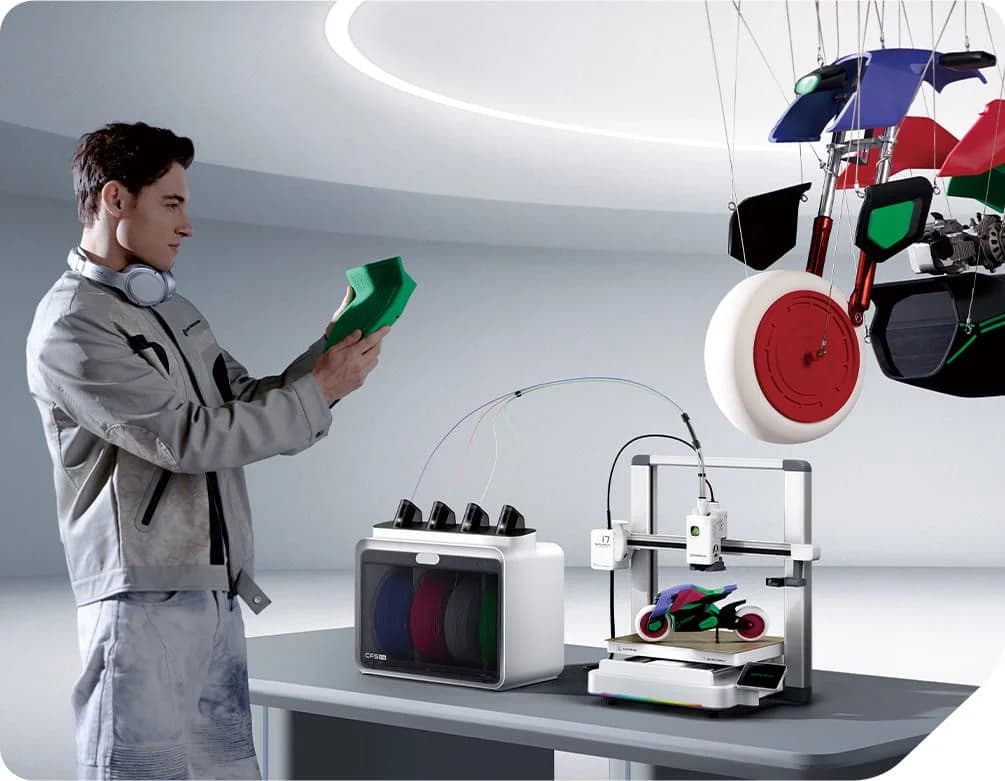
The SPARKX i7 is Creality's beginner-friendly multicolor desktop printer. Creality says it goes from unboxing to printing in under five minutes, with no assembly on the Color Combo (the only version that arrives fully assembled), and that calibration is automatic: bed leveling for the target print area, nozzle Z-offset and input shaping all run before printing starts.
Safety and monitoring come from a 720p AI camera with lighting that watches for spaghetti, air printing, entanglement and build plate problems. A full-color RGB light bar shows print status and can be customized. Multicolor uses CFS nano, CFS Lite or CFS Mini units, and Creality claims 50% less purge waste and faster color switching than its previous-generation multicolor printer. The software side adds CubeMe, an AI tool that turns portraits into printable 3D models.
Key specs (Creality):
- Build volume: 260 × 260 × 255 mm
- Speed: up to 500 mm/s, acceleration up to 10,000 mm/s²
- Nozzle and bed: up to 300 °C and 100 °C, quick-swap hotend
- Filaments: PLA, PETG, PLA-CF, TPU (Shore 64D or harder)
- Extras: 2.85-inch touchscreen, 720p AI camera, RGB status light, direct drive extruder
Best for: newcomers who want multicolor without a lot of setup.
Creality SPARKX i7
A beginner-friendly multicolor printer with a 260 mm build area, an AI camera and fast setup.
Opens the Creality store page in a new tab. Check current price and availability there.
See it in the Creality storeCreality Hi Combo
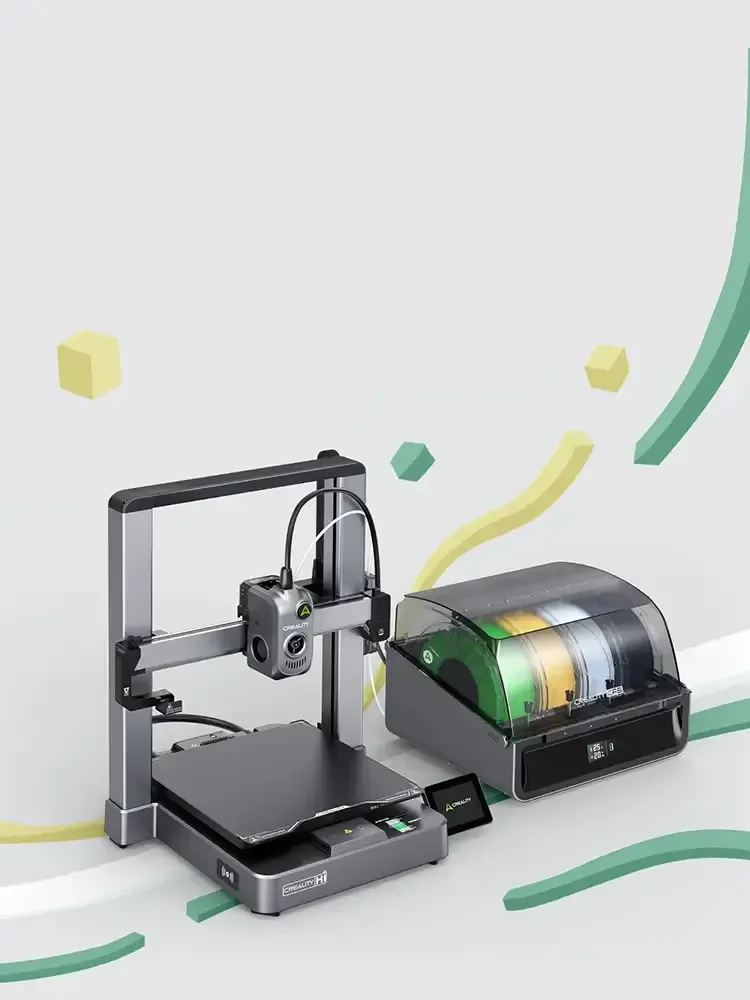
The Creality Hi is positioned as a "wonderful choice for multicolor 3D printing," with an all-metal body whose frame parts are die-cast aluminum alloy. Creality says it ships about 95% pre-assembled for easy setup, and pairs with the CFS: up to four units for 16 colors, though the Combo includes just one.
Automation includes auto leveling, auto filament identification and loading, filament tangle detection and a built-in RFID reader for scanning filament information when printing in a single color. The extruder is modular for easier repairs, with metal gears, an automated filament cutter and a tri-metal quick-swap nozzle tipped with hardened steel. An input shaping algorithm reduces ringing at speed.
The printer also supports the Fluidd web interface, with expert mode and root access for tinkerers. Note that Creality says the filament management system is not compatible with TPU, damp BVOH/PVA or warped cardboard spools.
Key specs (Creality):
- Build volume: 260 × 260 × 300 mm
- Speed: 300 mm/s typical, up to 500 mm/s; acceleration up to 12,000 mm/s²
- Nozzle and bed: up to 300 °C and 100 °C
- Filaments: Hyper-PLA, PLA, PETG, ABS, PLA-CF
- Multicolor: CFS, up to 4 units for 16 colors (Combo includes one)
Best for: people who want a sturdy metal multicolor printer that is quick to set up.
Creality Hi Combo
A mostly pre-assembled metal multicolor printer with auto leveling, an RFID reader and a CFS unit.
Opens the Creality store page in a new tab. Check current price and availability there.
See it in the Creality storeEnder-3 V3 Mega
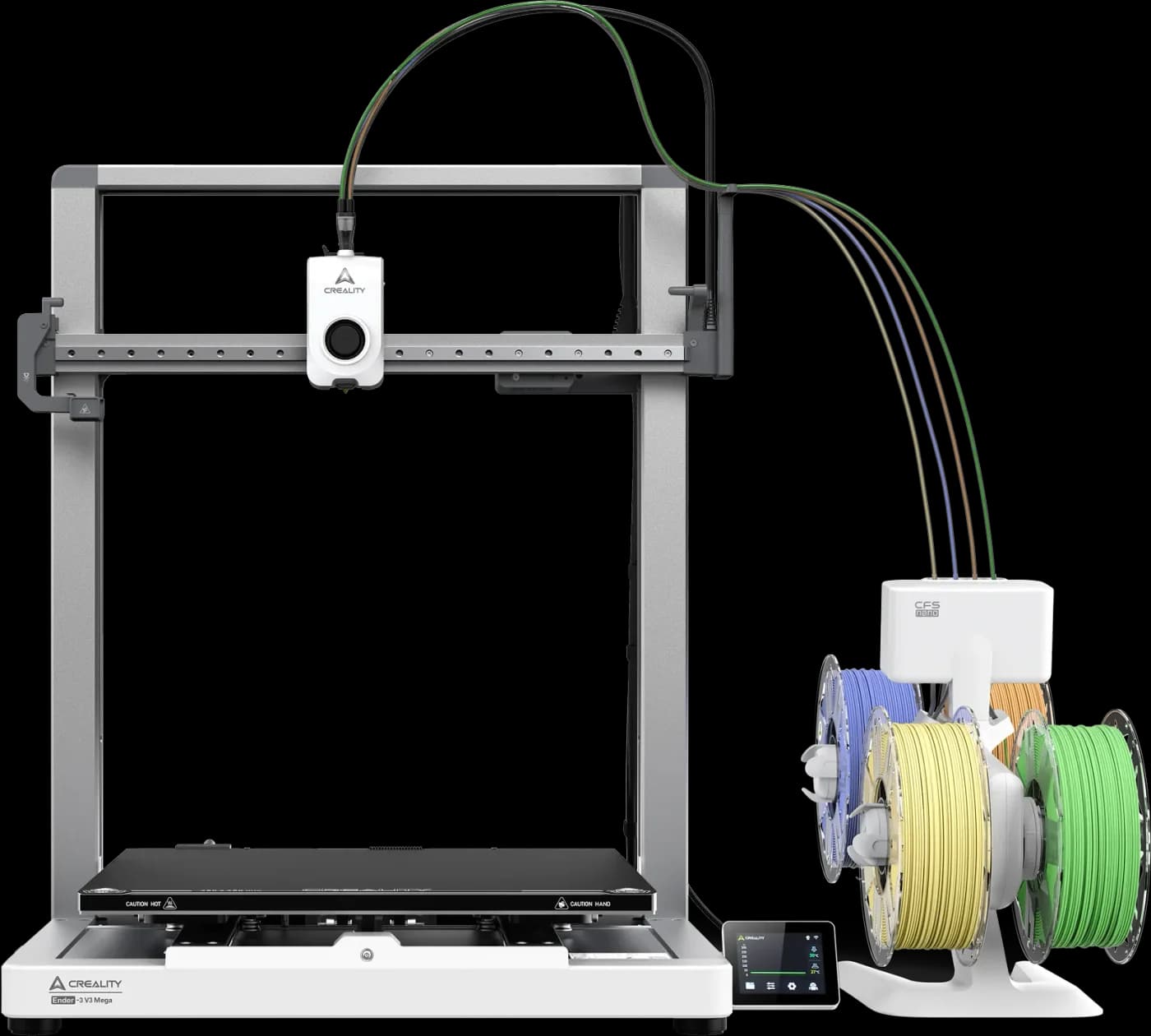
The Ender series is Creality's classic line, and the Ender-3 V3 Mega is its large-format member. It has a 420 × 420 × 420 mm build volume, which Creality says is nearly 96% more plate area than the previous Ender-3 V3 Plus, so large models can print in one piece with fewer splits and seams.
Creality calls it a TPU production specialist. Its Sprite 2 extruder shortens the feed path to reduce slipping, and the printer handles TPU from 85A to 95A. Dual Y motors drive the large plate at up to 500 mm/s, with dual Z motors and vibration compensation for stability. Maintenance features include 81-point auto leveling, filament tangle detection and a tool-free quick-swap nozzle.
Multicolor is available on the Mega Combo, which includes a CFS nano for automatic four-color switching. The standalone printer has automatic filament refill and needs an optional CFS nano for multicolor.
Key specs (Creality):
- Build volume: 420 × 420 × 420 mm
- Speed: 300 mm/s typical, up to 500 mm/s
- Size and weight: 590 × 588 × 697.5 mm, 21.2 kg standalone (23.0 kg Combo)
- Display: 3.2-inch color touchscreen; Wi-Fi, USB and Creality Cloud
- Materials: TPU from 85A to 95A, among others
Best for: makers who regularly print large parts or flexible TPU items.
Creality Ender-3 V3 Mega
A 420 mm cube printer built for large prints and TPU, with an optional CFS nano Combo.
Opens the Creality store page in a new tab. Check current price and availability there.
See it in the Creality storeHALOT-X1 Neo

Resin printing is where Creality's HALOT series sits, and the HALOT-X1 Neo is its beginner-friendly 9K printer, aimed at newcomers and people switching from filament. It has a 6.8-inch 9K LCD (8520 × 4320) with an 18 μm pixel size, layers of 0.01–0.2 mm and a pre-leveled build platform, so it is ready to print out of the box.
Creality describes a plug-and-play workflow with a QR code on the cover linking to Creality Wiki tutorials. It connects via USB drive, Wi-Fi and Creality Cloud, and works with HALOT BOX and CHITUBOX slicers, with Lychee support listed as coming soon. The bundle includes AI model generation credits through FanForge and a CHITUBOX Pro trial, and Creality sells a wash and cure machine and the Nebula AI camera separately.
The build volume is small at 153.36 × 77.76 × 160 mm and maximum speed is 60 mm/h at 0.2 mm layers, so it suits miniatures and small parts. For more space, Creality's comparison lists the larger HALOT-X1 and X1 Max.
Key specs (Creality):
- Screen: 6.8-inch 9K, 8520 × 4320, 18 μm XY accuracy
- Build volume: 153.36 × 77.76 × 160 mm
- Speed: up to 60 mm/h at 0.2 mm layers
- Machine: 235.5 × 230 × 395.5 mm, 4.38 kg, 65 W
- Connectivity: USB, Wi-Fi (2.4G), Creality Cloud
Best for: beginners and tabletop or miniature fans who want a compact resin printer.
Creality HALOT-X1 Neo
A beginner-friendly 9K resin printer with a pre-leveled platform and Wi-Fi.
Opens the Creality store page in a new tab. Check current price and availability there.
See it in the Creality storeFalcon A1C
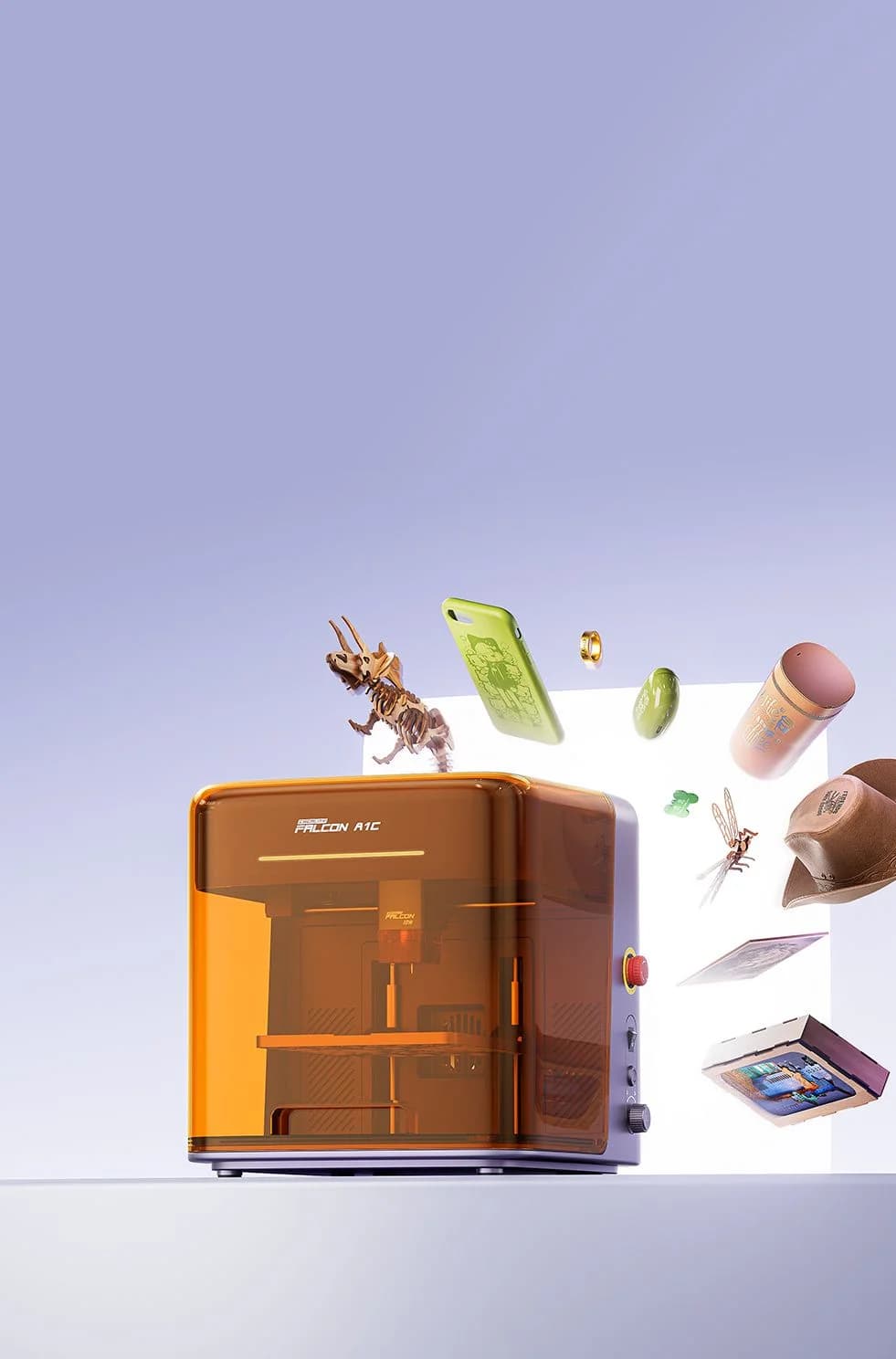
Creality's Falcon line covers laser engravers, and the A1C is positioned as the first laser engraver for a home. Its distinctive idea is interchangeable laser modules: you can swap between 5W diode, 10W diode and 1.2W infrared modules in seconds without tools, so one machine covers different materials.
It has true autofocus and a smart lifting platform, so you place a material and click, with no manual height adjustment. The version with a camera adds camera-assisted positioning and AI smart fill and layout. The working area is 150 × 150 mm with a maximum processing height of 148 mm, and speed reaches 15,000 mm/min.
Safety is listed as Class 1 laser safety with flame detection, tilt detection and a USB safety lock. Control is by PC or app over Wi-Fi and Bluetooth, and a rotary kit and air purifier are optional extras.
Key specs (Creality):
- Working area: 150 × 150 mm, max processing height 148 mm
- Laser modules: 5W diode, 10W diode, 1.2W IR, tool-free swap
- Speed: up to 15,000 mm/min, auto focus
- Safety: Class 1, flame and tilt detection, USB safety lock
- Size: 336 × 377 × 341 mm, 9.8 kg (machine only)
Best for: first-time laser users who want a compact, easy-to-use engraver for gifts and small projects.
Creality Falcon A1C Laser Engraver
A compact home laser engraver with tool-free interchangeable modules, auto focus and Class 1 safety.
Opens the Creality store page in a new tab. Check current price and availability there.
See it in the Creality storeCreality Pika
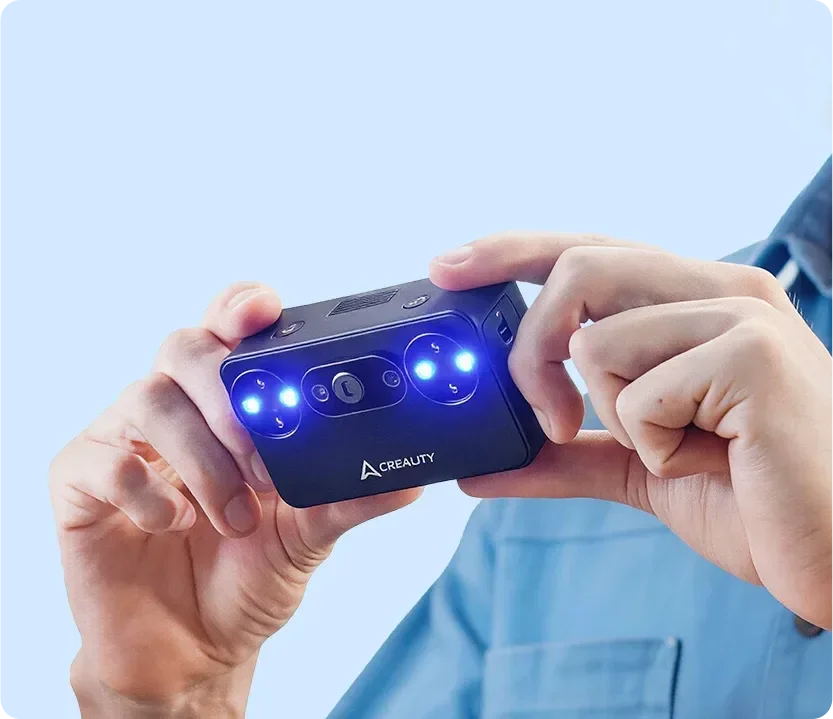
Creality Pika is a portable scanner rather than a printer, but it fits the same workflow: scan a real object, clean up the model and print it. Creality describes it as a smartphone-like AI scanner that weighs 260 g and measures about 100 × 60 × 35 mm, with a 3-inch touchscreen.
It combines two scanning modes: seven parallel blue lasers for fine detail, with accuracy up to 0.03 mm, and NIR structured light for body scanning and 24-bit color capture, with accuracy up to 0.1 mm. On a PC it captures up to 110 fps, and Creality says it can scan black and metal objects without spray. Scan volumes range from 10 mm cubed to 2,000 mm cubed.
Two swappable 3,350 mAh batteries are included. The CrealityScan software handles scanning, optimization and basic editing, and models export as STL, OBJ, PLY or ASC. AI retexturing, hole filling and body completion are currently PC-only, marker-free laser scanning works in wired PC mode and Gaussian Splatting is listed as coming soon.
Key specs (Creality):
- Accuracy: up to 0.03 mm (blue laser), up to 0.1 mm (NIR)
- Speed: up to 110 fps on PC (blue laser)
- Scan range: 10 × 10 × 10 mm to 2000 × 2000 × 2000 mm
- Weight: 260 g, with two 3,350 mAh batteries
- Export: STL, OBJ, PLY, ASC
Best for: makers who want to scan objects, figures or parts and turn them into printable models.
Creality Pika 3D Scanner
A 260 g handheld scanner with blue laser and NIR modes, up to 0.03 mm accuracy and two swappable batteries.
Opens the Creality store page in a new tab. Check current price and availability there.
See it in the Creality storeHow to choose between them
Start with what you want to make, then match the technology and size.
| If you want... | Look at |
|---|---|
| The biggest multicolor machine, with a heated chamber | K2 Plus Combo |
| An easy multicolor start with AI monitoring | SPARKX i7 |
| A sturdy metal multicolor printer, mostly assembled | Creality Hi Combo |
| Very large prints or flexible TPU | Ender-3 V3 Mega |
| Fine detail in a compact resin printer | HALOT-X1 Neo |
| To engrave or cut with a beginner-friendly laser | Falcon A1C |
| To scan real objects into 3D | Creality Pika |
Of the four filament printers, the K2 Plus has the largest volume with a heated chamber, the SPARKX i7 and Hi suit multicolor beginners, and the Ender-3 V3 Mega is the pick when size or TPU matters most. If you are weighing Creality against another brand, our ELEGOO guide covers its own enclosed multicolor printer, resin printers and laser.
Things to know before buying
- Combo versus standalone. Combos include one CFS unit, and 16 colors need three more, so check the contents. Some printers need an optional CFS for multicolor.
- Speed claims are best cases. Top speeds and noise figures come from Creality's lab conditions. Typical speeds are lower (the K2 Plus lists 300 mm/s as typical).
- Filament limits. Some systems do not work with every material, such as TPU on the Hi's filament management system or SPARKX i7 limits on soft TPU.
- Resin needs a workflow. The HALOT needs gloves, ventilation, washing and curing, and the wash and cure machine and camera are separate.
- Lasers need care. Use eye protection, ventilation and supervision, and check which module suits your material.
- Scanner features vary by mode. Some Pika features are PC-only or need wired mode, and Gaussian Splatting is not yet available.
- Prices and stock change. Check the store for the current price, bundles and availability.
Questions readers ask
Which Creality printer is best for beginners?
Creality positions the SPARKX i7 (multicolor) and the HALOT-X1 Neo (resin) as beginner-friendly, with automation and quick setup. The right one depends on whether you want filament or resin.
What is CFS?
CFS stands for Creality Filament System, a multi-spool unit that feeds up to four colors. Up to four units can be combined for 16 colors on the K2 Plus and Hi.
Which model has the largest build volume?
The Ender-3 V3 Mega is 420 × 420 × 420 mm and the K2 Plus is 350 × 350 × 350 mm, according to Creality.
Can the Falcon A1C change laser power?
It supports interchangeable 5W diode, 10W diode and 1.2W IR laser modules that swap without tools.
What can the Creality Pika scan?
Creality lists a scan range from 10 mm cubed to 2,000 mm cubed, with up to 0.03 mm accuracy in blue-laser mode.
Did you test these products?
No. This guide is based on Creality's official product pages. We have not hands-on tested them.
Affiliate notice. Some links on this page may become affiliate links. If you buy through them we may earn a commission at no extra cost to you, and it never changes what we recommend. Read our affiliate disclosure.
Related stories
 Maker tech
Which ELEGOO Machine Is Right for You? Six 3D Printers and a Laser Engraver Compared
A buyer's guide to seven ELEGOO machines: Centauri Carbon 2 Combo, Neptune 4 Pro, OrangeStorm Giga, Mars 5 Ultra, Saturn 4 Ultra 16K, Jupiter 2 and the Phecda laser engraver.
Read moreMechanical keyboards for beginners: switches, sizes and what to skip
A plain-language guide to switch types, layouts, keycaps and the extras you can skip on your first mechanical keyboard.
Read moreNoise-cancelling headphones under $300: what to look for before you buy
How to choose active noise-cancelling headphones: comfort, codecs, battery, call quality and the claims worth ignoring.
Read more